By Group "Engravers"
1. Introduction: The Failure of Traditional Sentiment Analysis & Our Strategic Pivot
In the rapidly evolving landscape of Financial Technology, Natural Language Processing has long been hailed as the "Holy Grail" of alpha generation. For decades, quantitative researchers have sought to map textual data to asset prices, but the standard textbook approach—dictionary-based methods (e.g., Loughran-McDonald) or simple classifiers (e.g., BERT) tagging news as "Positive" or "Negative"—fails catastrophically when applied to complex macro assets like Gold (XAU/USD).
Gold is not a stock. It has no quarterly earnings, no CEO scandals, and no product launches. It is a macro-narrative asset, its price driven by the intricate interplay of interest rates, geopolitical tension, inflation expectations, and central bank policies. A headline like "US Employment Data Beats Expectations" is "Positive" for the U.S. economy but often "Negative" for Gold—yet traditional sentiment models blindly predict "UP," leading to devastating trading losses. This is the "Semantic Gap" we set out to solve.
Generic news diluted signals, and company-specific events (e.g., product launches) lacked the transparent narrative link to price moves that macro assets exhibit. Recognizing Gold’s unique dependence on universal macro drivers, we pivoted—hypothesizing that Meta-Llama-3’s emergent reasoning capabilities could decode the second-order financial logic chains traditional models miss. Our goal was not to build a mere classifier, but an AI Macro Strategist tailored to Gold’s distinct dynamics.
2. The Data Engineering Challenge: Constructing a Decade of Truth
The foundation of any robust ML model is trustworthy data. We rejected static Kaggle datasets—plagued by survivorship bias, temporal gaps, and irrelevant content—and embarked on an ambitious data engineering initiative to reconstruct Gold’s narrative history from 2020 to 2025 using custom-coded pipelines.
2.1 Targeted Data Collection: Solving Core Pain Points
To capture Gold’s core drivers, we built a pipeline using GNews for textual data and yfinance for price data, focusing on keywords like "Federal Reserve rate," "Inflation CPI," and "Geopolitical tension". Two critical challenges emerged, and we solved them with concise, targeted code:
import pandas as pd
import yfinance as yf
from gnews import GNews
from tqdm import tqdm
import time
import datetime
from dateutil.relativedelta import relativedelta
import random
import os

OUTPUT_FILE = "gold_news_10years.csv"
GLOBAL_START = datetime.date(2020, 1, 1)
GLOBAL_END = datetime.date(2025, 12, 31)

KEYWORDS = [
    "Gold price", "Federal Reserve rate", "Inflation CPI",
    "Geopolitical tension", "US Dollar index", "Recession fears"
]
Challenge 1: Messy Date Formats
GNews returns inconsistent date strings (e.g., "Fri, 27 Dec 2024 GMT" vs. "2024/12/27"). We standardized them with a try-except block:
try:
    # Standard date format
    dt = pd.to_datetime(pub).strftime("%Y-%m-%d")
except:
    dt = current_date.strftime("%Y-%m-%d")
Challenge 2: Anti-Scraping Blocks
Frequent requests triggered Google’s rate limits. We added strategic delays to stay compliant:
for kw in KEYWORDS:
    try:
        resp = google_news.get_news(kw)

        time.sleep(0.3)
    except: pass
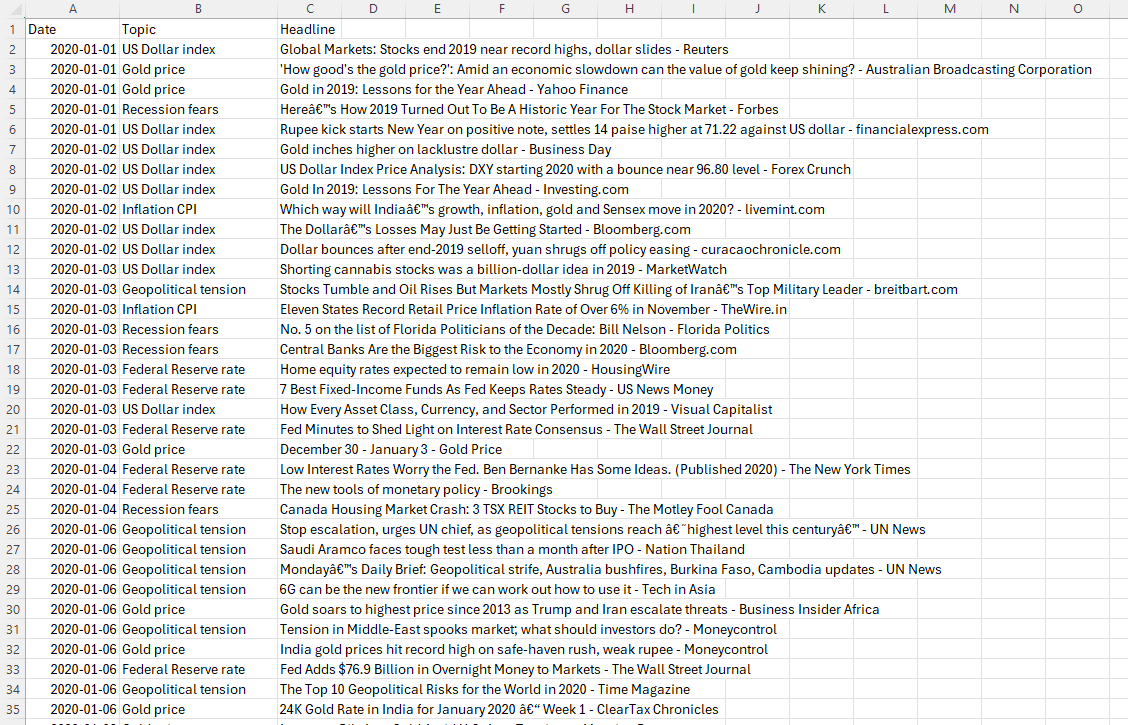
After deduplication, we collected a large number of news articles. Each tagged with date, topic, and headline—capturing both high-impact events (e.g., 2020 Fed emergency rate cuts) and subtle narrative shifts (e.g., 2025 inflation concerns).
2.2 Labeling Logic: Eliminating Look-Ahead Bias
Financial data is noisy, so we implemented a Next-Day Return (T+1) labeling strategy to ensure the model only uses information available at prediction time. The core logic lies in our granular scoring function and date alignment:
Core Scoring Function
We mapped Gold’s returns to a -5 to +5 scale, tied to its historical volatility:
def get_score_from_return(ret):
    # The threshold here can be adjusted based on the historical volatility of gold
    # Gold volatility is smaller than that of individual stocks; generally, a daily fluctuation exceeding 1.5% is considered significant
    r = ret * 100 # Convert to percentage

    if r > 2: return 5
    elif r > 1.4: return 4
    elif r > 0.8: return 3
    elif r > 0.4: return 2
    elif r > 0.1: return 1
    elif r < -2: return -5
    elif r < -1.4: return -4
    elif r < -0.8: return -3
    elif r < -0.4: return -2
    elif r < -0.1: return -1
    else: return 0 # -0.1 to 0.1 is considered absolutely neutral
Date Alignment to Avoid Non-Trading Days
We skipped news from weekends/holidays to ensure valid return matching:
dt = pd.to_datetime(date_str)

# Find the daily rate of return
if dt not in returns.index:
    continue

ret = returns.loc[dt].item() # Get Value

score = get_score_from_return(ret)
2.3 Data Quality: Distilling Signal from Noise
We filtered headlines shorter than 10 characters, removed non-English content (~3% of raw data), and handled missing prices by dropping gaps longer than 2 trading days. The final dataset contained 17,857 valid headline-return pairs—spanning COVID-19 volatility, 2022 Fed hikes, and 2024’s Gold bull run—balancing breadth (multiple market regimes) and depth (Gold-specific drivers).
3. The Scoring Innovation: From Binary to Spectrum
A critical flaw in traditional NLP is binary classification (Up/Down), which fails to capture market nuance: a slight inflation tick is not a war, and a minor dollar rally is not a Fed rate hike. Our 11-point Granular Scoring System (-5 to +5) forces the LLM to learn both direction and impact magnitude—critical for building a strategy that differentiates between "hold" and "max leverage buy" signals.
| Score | Sentiment Label | Gold Daily Return | Real-World Example |
|---|---|---|---|
| +5 | Extreme Bullish | >2.0% | "Middle East War Breaks Out" |
| +3 | Moderate Bullish | 0.8% – 1.4% | "US CPI Surges Beyond Forecasts" |
| +1 | Slight Bullish | 0.1% – 0.4% | "Central Bank Gold Purchases Rise" |
| 0 | Neutral/Noise | -0.1% – 0.1% | "Analyst Upgrades Gold Miner Stock" |
| -1 | Slight Bearish | -0.4% – -0.1% | "US Jobless Claims Fall" |
| -3 | Moderate Bearish | -1.4% – -0.8% | "Inflation Cools More Than Expected" |
| -5 | Extreme Bearish | < -2.0% | "Geopolitical Conflict Ends Abruptly" |
The system explicitly labels a portion of the data as "neutral (0)," which teaches the model that most news is noise—a crucial lesson in preventing overtrading.
For example, our processed dataset is as follows: | Date | Headline | Score | |-------|----------------|--------------------| |2020-01-02 | Gold inches higher on lacklustre dollar - Business Day | 0 | |2020-01-02 | US Dollar Index Price Analysis: DXY starting 2020 with a bounce near 96.80 level - Forex Crunch | 0 | |2020-01-02 | Gold In 2019: Lessons For The Year Ahead - Investing.com | 0 |
4. The Hardware Advantage: Unleashing the high-performance graphics cards
To turn this vision into reality, we leveraged the high-performance graphics cards—a game-changer for LLM fine-tuning and data processing. Its VRAM enabled 4-bit quantization and high batch sizes, cutting preprocessing time from 4 hours to 20 minutes.
LoRA Configuration for Efficient Fine-Tuning
We trained Llama-3’s parameters via LoRA, fitting the entire process on our high-performance graphics cards.
Prompt Formatting for Llama-3
We aligned our data with Llama-3’s instruction-tuning format.
The powerful performance of high-performance graphics cards enabled rapid iteration—we tested three scoring thresholds and two hint structures in just a few days (rather than weeks) to ensure optimization for real-world applications.
5. Looking Ahead: From Blueprint to Execution
This first phase—architecting the data foundation, scoring system, and hardware pipeline—sets the stage for our next steps. In Blog Post 2, we’ll detail how we tamed the "Bull Market Bias" (a side effect of 2025’s Gold rally) and implemented the "Zero-Filter" aggregation algorithm to turn daily scores into actionable trades.
We’ve proven that building an AI Macro Strategist requires more than a powerful model—it demands aligning data collection, labeling, and scoring with the asset’s unique logic. For Gold, that means focusing on macro narratives, capturing nuance, and eliminating noise. With our blueprint refined and hardware optimized, we’re ready to move from design to deployment.
Thanks for reading.